


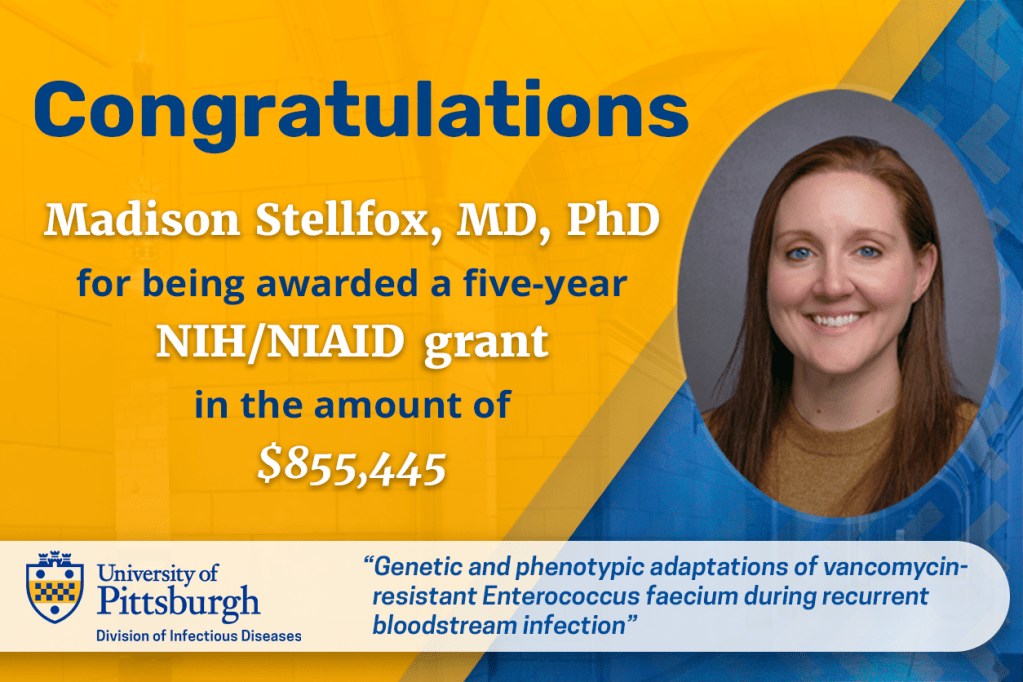
We are pleased to announce that Madison E. Stellfox, MD, PhD, has been awarded funding in the amount of $855,445 for a five-year grant by the National Institutes of Health/National Institute of Allergy and Infectious Diseases (NIH/NIAID) entitled, “Genetic and phenotypic adaptations of vancomycin- resistant Enterococcus faecium during recurrent bloodstream infection.” This proposal was submitted in response to the competitive funding opportunity entitled, “Mentored Clinical Scientist Research Career Development Award (Parent K08 Independent Clinical Trial Not Allowed)” under funding opportunity number PA-20-203.
Enterococcus faecium is a normal member of the healthy human microbiota; however, it has become a concerning opportunistic pathogen. E. faecium is resistant to many first-line antibiotics and most clinical isolates are also vancomycin-resistant (VREfm), leaving high-risk patients with few treatment options. As such, infections caused by VREfm are challenging to manage, and ~10% of patients with VREfm bloodstream infections will go on to develop recurrent disease. It is largely unknown how VREfm adapts within its host to evade eradication by standard antimicrobial therapies and cause recurrent infections, as few systematic genomic or phenotypic assessments have been performed in VREfm. Dr. Stellfox’s research will address this important knowledge gap by 1) comparative genomic analyses of VREfm bloodstream isolates collected from patients with recurrent infections to find genetic signatures associated with the potential to resist eradication and cause recurrence; and 2) determining the role of antibiotic tolerance in recurrent VREfm disease.
Bacteriophage (phage) therapy has the potential to provide clinicians with an additional tool for treating challenging enterococcal infections, but transitioning phage therapy into clinical practice has been stymied by the limited generalizability of small pre-clinical studies and the lack of pharmacokinetic- guided dosing regimens. These limitations can be addressed by 1) combining a broad-spectrum phage cocktail with VRE-targeting antibiotics against the cohort of recurrent VREfm isolates proposed to assess for phage-antibiotic synergism and 2) developing a one-compartment pharmacokinetic model to determine optimal dosing strategies to inform future clinical use. This collection of VREfm isolates will provide a representative cross-section of strains likely to fail standard antibiotic therapies, and enable a thorough assessment of phage-antibiotic combinations as potential treatment options for complex VREfm infections in the future.
Please join us in congratulating Madison!
 ID PittStop
Leave a comment