

First year ID fellow Alina Iovleva presented an interesting case of pulmonary infection with Blastomyces dermatitidis (blastomycosis) at Pitt ID Grand round on 12/8/16. The case was illustrative in that the sputum cytology was misleading and initial sputum cultures grew Candida species, though eventually the pathogen was recovered in culture.
Of note both the urine Histoplasma antigen and the urine Blastomyces antigen were positive. This is not an uncommon scenario. Given these endemic mycoses can take time to grow, we often rely on antigen (and antibody) testing in endemic mycoses.
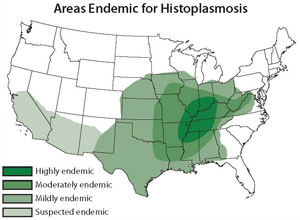
This is a particularly difficult challenge when dealing with pathogens that have overlapping geographical epidemiology:

Antigen testing is helpful because it had reasonable sensitivity and turn around time:
- One study found the following:
- Blastomyces antigenuria was present in 90% of patients with the disease
- 99% of patients without fungal disease had negative antigen testing
- 96% of patients with histoplasmosis had a positive blastomyces antigen (usually a higher quantitative level)
- A second study of blastomyces antigen found a slightly lower sensitivity (76% overall for urine 80% for urine + serum)
- Regarding Histoplasma antigen, 92% of patients with Histoplasmosis had positive Histoplasma antigenuria
- 90% of patients with Blastomycosis also had positive Histoplasma antigenuria.
Overall these data suggest that neither the Histoplasma nor the blastomyces antigens can differentiate between the two infections. One study did suggest that B. dermatitis antibodies to BAD-1 protein may be much more specific to Blastomyces yielding a sensitivity of 87.8% and the specificity was 99.2%. Of note in the specific Histoplasma + group tested, only 6% were positive for BAD-1 antibodies based on this cutoff. These antibodies may be helpful in the future to differentiate but antibody response is often delayed so there may be false negatives in early testing.
Overall when approaching endemic mycoses, there seems to be some role for each of the following in arriving at the correct diagnosis: travel and epidemiological history, antigen testing, fungal culture (sputum and tissue), cytology/pathology, and antibody testing.
References:
 ID PittStop
Leave a comment